01 · FOUNDATIONS
From amino acids to biological signals
Amino acids connect when the carboxyl group of one reacts with the amino group of another, forming a peptide bond. The resulting chain has a beginning called the N-terminus and an end called the C-terminus. Even a small change in sequence can alter the molecule’s shape, stability, and biological activity.
There is no single universal cutoff between a peptide and a protein. Peptides are generally shorter chains, while proteins are usually longer and fold into more complex structures. Terms such as dipeptide, tripeptide, oligopeptide, and polypeptide describe chains of different lengths.
AMINO ACIDPEPTIDE BONDAMINO ACIDPEPTIDE BONDAMINO ACID
02 · BIOLOGY
What peptides do in the body
Natural peptides act as hormones, neurotransmitters, growth factors, immune signals, antimicrobial defenses, and regulators of appetite, blood pressure, pain, digestion, reproduction, and metabolism. Many work by binding to a receptor on a cell and triggering a signaling cascade inside that cell.
Hormonal signalingCoordinates activity between organs and tissues.
Neural communicationModulates signaling within the nervous system.
Immune regulationHelps organize inflammatory and defense responses.
Cellular processesInfluences growth, repair, metabolism, and gene expression.
03 · A FAMILIAR EXAMPLE
Insulin is a peptide hormone
Human insulin contains 51 amino acids arranged in two peptide chains connected by disulfide bonds. Produced naturally by pancreatic beta cells, it signals cells to manage glucose and energy storage. Its discovery transformed both medicine and biotechnology.
Other peptide-based or peptide-related medicines include oxytocin, vasopressin analogues, calcitonin, glucagon, and GLP-1 receptor agonists. Approval applies to a specific drug, formulation, dose, manufacturer, and intended use—not to peptides as a general category.
04 · A BRIEF HISTORY
More than a century of peptide science
1901–1902Emil Fischer advanced the chemistry of amino acids and introduced the concept and terminology of peptide bonds.
1921–1922Insulin was isolated in Toronto and first used clinically, demonstrating the extraordinary medical potential of peptide hormones.
1953Vincent du Vigneaud’s team achieved the first chemical synthesis of a peptide hormone, oxytocin.
1960s–1980sSolid-phase peptide synthesis and recombinant DNA technology made peptide production more systematic and scalable.
TodayResearchers design peptide analogues with altered stability, selectivity, duration, and delivery properties for science and medicine.
05 · DESIGN & MANUFACTURING
How laboratory peptides are made
Solid-phase peptide synthesis builds a chain step by step on a resin support. Each protected amino acid is added in sequence, followed by cleavage, purification, and analytical testing. This method is widely used for short and medium-length research peptides.
Recombinant production uses engineered cells to produce larger or more complex peptide and protein molecules. After production, the material must be isolated, purified, characterized, and prepared in a stable form.
Many peptide materials are lyophilized—freeze-dried—to improve storage stability. Their sensitivity to moisture, heat, light, oxidation, and repeated handling varies with sequence and formulation.
06 · QUALITY & ANALYSIS
What researchers evaluate
IdentityDoes the material match the intended molecular sequence or mass?
PurityWhat proportion of detected material is the target compound?
ContentHow much target peptide is actually present in the vial?
ContaminantsAre water, residual solvents, microbes, or endotoxins controlled?
Purity is not the same as quantity. A high HPLC purity result describes the relative chromatographic composition of a sample; it does not by itself confirm vial content, identity, sterility, or suitability for any particular use.
07 · WHY PEPTIDES ARE CHALLENGING
Precision comes with limitations
Peptides can be highly selective, but they may also be rapidly broken down by enzymes, cleared from circulation, poorly absorbed through the digestive tract, or unable to cross certain biological barriers. Scientists may modify amino acids, cyclize a chain, attach lipids or polymers, or change the formulation to study stability and duration.
08 · RESEARCH AREAS
Where peptide science is used
Metabolic signalingNeuroscienceImmunologyCell communicationMicrobiologyDiagnosticsBiomaterialsDrug discovery
09 · KEY TERMS
A quick glossary
- Analogue
- A related molecule intentionally modified from a natural sequence.
- Agonist
- A molecule that activates a receptor and produces a biological response.
- Antagonist
- A molecule that blocks or reduces receptor activation.
- Half-life
- The time required for the amount of a substance to decrease by half in a defined system.
- Lyophilized
- Freeze-dried to remove water and improve storage stability.
- Receptor
- A cellular protein that recognizes a signaling molecule and initiates a response.
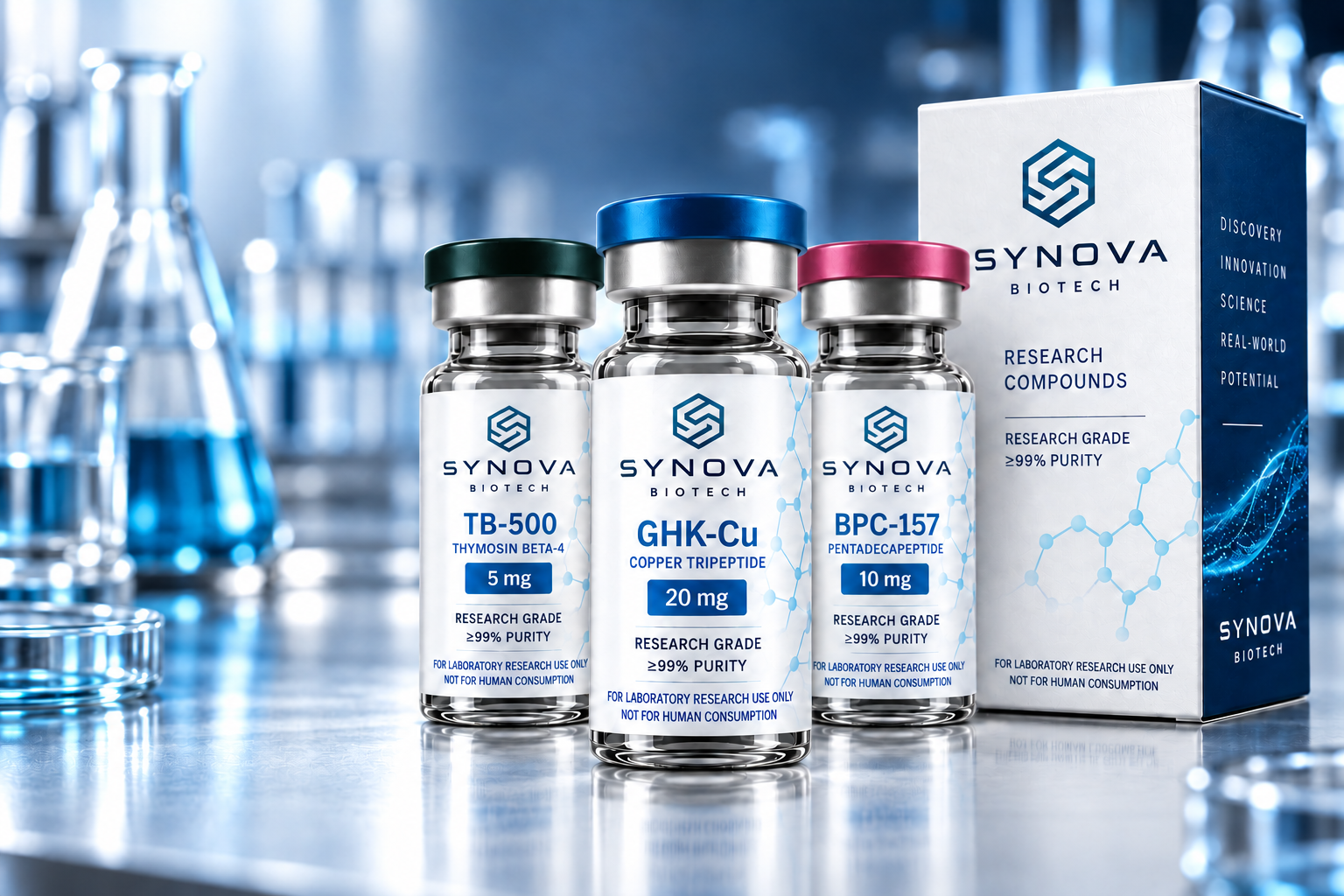
Research material is not automatically a medicine.Some peptides are established, regulator-approved medicines. Others are investigational, unapproved, or supplied strictly for laboratory research. Purity testing alone does not establish safety, effectiveness, sterility, dosage, or approval for human or veterinary use.